
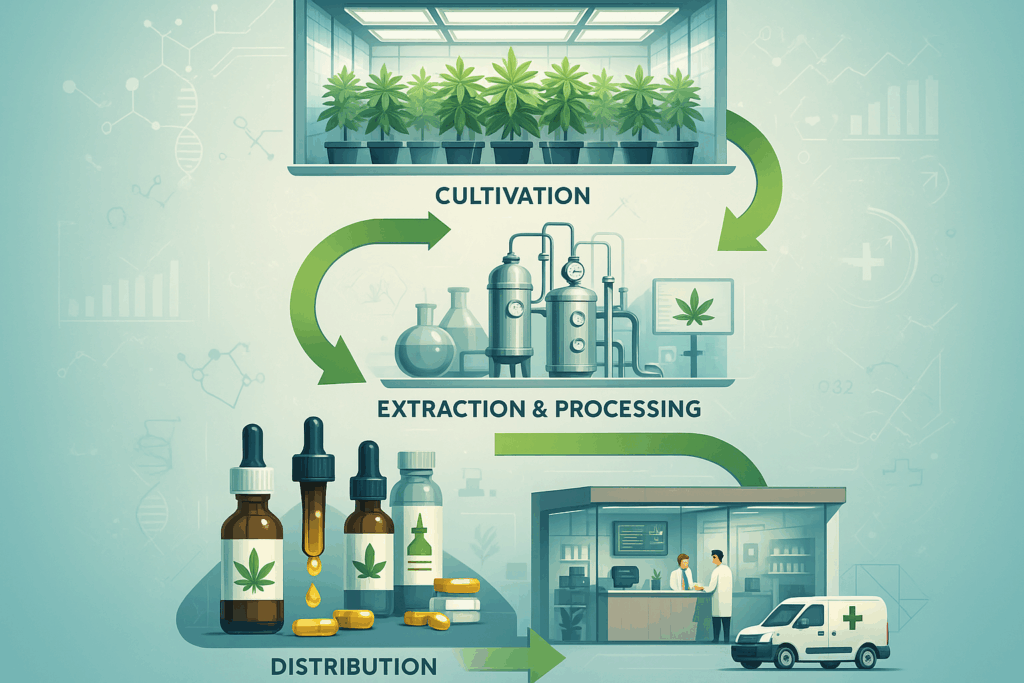
The cannabis industry is growing up fast, and smart companies are taking notes from Big Pharma’s playbook. Vertical integration cannabis strategies are revolutionizing how medical marijuana reaches patients, creating a seamless journey from seed to sale.
Leading cannabis companies are ditching the fragmented approach for total supply chain control. This shift mirrors pharmaceutical giants who’ve mastered cannabis supply chain management for decades. The result? Better products, happier customers, and fatter profit margins.
1. The Pharmaceutical Blueprint: How Big Pharma Mastered Supply Chain Control
Learning from the Masters of Medicine
Pharmaceutical companies didn’t stumble into vertical integration – they strategically built empires. Companies like Johnson & Johnson control everything from raw materials to retail distribution. Their pharma cannabis strategy involves owning manufacturing facilities, research labs, and distribution networks.
This approach eliminates middlemen who might compromise quality or inflate costs. When Pfizer produces a medication, they control every ingredient and manufacturing step. Cannabis companies are adopting this same philosophy with impressive results.
Take Canopy Growth Corporation, which operates cultivation facilities, extraction labs, and retail dispensaries. Their vertical approach ensures consistent THC and CBD levels across products. Quality control becomes manageable when you own every step of production.
The pharmaceutical model also emphasizes regulatory compliance at every level. Cannabis companies following this blueprint build compliance into their DNA. They’re not scrambling to meet regulations – they’re setting industry standards.
Research and development integration gives pharma companies competitive advantages. They can quickly pivot products based on market feedback. Cannabis companies with integrated R&D departments are developing innovative delivery methods and formulations.
Financial benefits of pharmaceutical vertical integration are substantial and measurable. Companies report 15-30% cost savings by eliminating third-party markups. Profit margins improve when you’re not paying external suppliers and distributors.
Building Integrated Infrastructure Like Pharma Giants
Pharmaceutical companies invest heavily in specialized facilities designed for specific functions. Their cultivation equivalent involves state-of-the-art manufacturing plants with strict environmental controls. Cannabis companies are building similar sophisticated growing and processing facilities.
Technology integration separates successful pharma companies from competitors in crowded markets. They use advanced analytics to optimize production schedules and inventory management. Cannabis companies are implementing similar systems to track plants from germination.
Quality assurance protocols in pharma are legendary for their thoroughness. Every batch undergoes rigorous testing before reaching consumers or patients. Cannabis companies adopting these standards are building consumer trust quickly.
Supply chain visibility gives pharmaceutical companies unprecedented control over their operations. They know exactly where every ingredient comes from and goes. Cannabis companies with similar tracking systems can recall products instantly.
Pharmaceutical companies also invest in specialized transportation and storage infrastructure. Temperature-controlled warehouses and vehicles ensure product integrity during distribution. Cannabis companies are building similar cold-chain logistics networks.
The pharmaceutical industry’s approach to supplier relationships emphasizes long-term partnerships. They work closely with key suppliers to ensure consistent quality. Cannabis companies are developing similar strategic relationships with equipment and packaging suppliers.
Strategic Partnerships vs. Full Ownership Models
Pharmaceutical giants carefully balance ownership with strategic partnerships for optimal efficiency. They own critical operations while partnering for specialized services or materials. Cannabis companies are learning when to build versus buy capabilities.
Some pharmaceutical companies partner with contract manufacturers for specific products. This approach allows flexibility without massive capital investments in facilities. Cannabis companies are using similar strategies for specialized extraction processes.
Distribution partnerships help pharmaceutical companies reach global markets without infrastructure investments. They maintain control over core products while leveraging partners’ networks. Cannabis companies are forming similar alliances with established distributors.
Research partnerships allow pharmaceutical companies to access specialized expertise and technologies. They collaborate with universities and biotech firms for innovation. Cannabis companies are partnering with research institutions for product development.
Risk management through partnerships helps pharmaceutical companies navigate regulatory challenges. Partners with specific expertise handle complex compliance requirements efficiently. Cannabis companies are partnering with regulatory specialists and legal experts.
The pharmaceutical industry’s licensing strategies generate revenue while maintaining control. They license products to partners while retaining manufacturing and quality oversight. Cannabis companies are exploring similar licensing opportunities for expansion.
2. Cannabis Supply Chain Challenges: From Seed to Shelf Complexities
Regulatory Maze Navigation
Cannabis companies face a regulatory landscape that makes pharmaceutical compliance look simple. Every state has different rules for cultivation, processing, testing, and sales. Companies operating across multiple states must navigate dozens of regulatory frameworks.
Seed-to-sale tracking requirements demand sophisticated software systems and meticulous record-keeping. Every plant must be tagged and monitored throughout its lifecycle. Compliance failures can result in license revocation and criminal charges.
Banking restrictions create unique challenges that pharmaceutical companies never face regularly. Most banks won’t work with cannabis companies due to federal illegality. This forces companies to operate largely in cash economies.
Tax implications under 280E prevent cannabis companies from deducting normal expenses. This creates significant financial burdens that pharmaceutical companies don’t encounter. Vertical integration helps minimize these tax disadvantages through strategic structuring.
Interstate commerce restrictions prevent cannabis companies from shipping across state lines. Each state operation must be completely self-contained and independent. This fragments supply chains and increases operational complexity significantly.
Quality testing requirements vary dramatically between states and create compliance nightmares. Some states require testing for pesticides while others focus on potency. Companies must adapt their processes for each jurisdiction’s specific requirements.
Quality Control Across Multiple Touchpoints
Cannabis cultivation requires precise environmental controls that rival pharmaceutical manufacturing standards. Temperature, humidity, lighting, and nutrients must be carefully monitored and adjusted. Small variations can dramatically impact final product quality and consistency.
Harvesting timing affects potency, flavor, and therapeutic effects of cannabis products. Unlike pharmaceutical ingredients, cannabis quality depends on subjective factors. Experienced cultivators develop intuition for optimal harvest timing through years.
Post-harvest processing involves multiple steps where quality can be compromised. Drying, curing, trimming, and storage all impact final product characteristics. Each step requires specialized knowledge and equipment for optimal results.
Extraction processes for concentrates and edibles require pharmaceutical-grade equipment and expertise. Solvent residues, contamination, and potency variations are constant quality concerns. Companies must invest heavily in testing and quality assurance protocols.
Product formulation for edibles, topicals, and tinctures involves complex chemistry. Achieving consistent dosing and bioavailability requires sophisticated understanding of cannabinoid behavior. Many cannabis companies lack this pharmaceutical-level expertise initially.
Packaging and labeling requirements vary by state and product type significantly. Compliance mistakes can result in product recalls and regulatory penalties. Companies must maintain detailed documentation for every product batch produced.
Distribution and Retail Coordination
Cannabis distribution networks are fragmented due to state-by-state regulatory requirements. Companies can’t leverage economies of scale like pharmaceutical distributors. Each state operation requires separate warehouses, vehicles, and distribution teams.
Inventory management becomes complex when dealing with perishable products and regulations. Cannabis flower has limited shelf life and must be rotated carefully. Tracking systems must account for waste, theft, and regulatory compliance.
Retail coordination requires managing relationships with independent dispensaries and company-owned stores. Each retail partner has different needs, preferences, and customer bases. Companies must balance consistency with local market adaptation requirements.
Pricing strategies must account for taxes, regulations, and local competition. Cannabis prices vary dramatically between states and even cities. Companies need sophisticated pricing models to remain competitive while maintaining margins.
Customer education is crucial since many cannabis consumers lack pharmaceutical knowledge. Budtenders need training on product effects, dosing, and interactions. Companies must invest in education programs for retail partners.
Returns and recalls in cannabis are complicated by regulatory requirements. Products can’t simply be returned to manufacturers like pharmaceuticals. Destruction protocols must follow strict state guidelines and documentation.
3. Success Stories: Cannabis Companies Mastering Vertical Integration
Curaleaf’s Multi-State Empire
Curaleaf has built the largest vertical integration cannabis operation in North America. They operate cultivation facilities, processing labs, and retail dispensaries across 23 states. Their integrated approach generates over$1.2 billion in annual revenue consistently.
The company’s cultivation strategy focuses on consistent genetics and standardized processes. They use the same growing techniques across all facilities for uniformity. This approach ensures their products have similar effects regardless of location.
Curaleaf’s processing capabilities include extraction, manufacturing, and packaging under one roof. They produce flower, concentrates, edibles, and topicals using integrated supply chains. Quality control is maintained through every step of production processes.
Their retail network includes over 140 dispensaries operating under consistent branding. Customers receive similar experiences whether shopping in Florida or Massachusetts. This brand consistency builds customer loyalty and trust effectively.
Technology integration allows Curaleaf to optimize operations across all facilities simultaneously. They use data analytics to predict demand and adjust production. Inventory management systems prevent stockouts and reduce waste significantly.
Financial performance demonstrates the power of their integrated model clearly. Gross margins exceed 50% due to eliminated third-party markups and fees. Operating leverage increases as they scale operations across states.
Green Thumb Industries’ Strategic Approach
Green Thumb Industries (GTI) operates a sophisticated cannabis supply chain management system. They control cultivation, manufacturing, and retail across 15 states strategically. Their Rise dispensary brand has become synonymous with quality and consistency.
GTI’s cultivation facilities use advanced hydroponic systems and climate control technology. They’ve standardized growing processes to ensure consistent cannabinoid profiles. Each facility produces the same strains with identical characteristics reliably.
Manufacturing capabilities include state-of-the-art extraction and processing equipment nationwide. They produce their own branded products including Rythm and Dogwalkers. Vertical integration allows them to control costs and quality simultaneously.
Their retail strategy focuses on premium locations and customer experience. Rise dispensaries feature modern designs and knowledgeable staff members. Customer satisfaction scores consistently rank among the industry’s highest.
Brand development has been central to GTI’s vertical integration strategy. They’ve created recognizable brands that command premium pricing power. Consumers specifically seek out GTI products at competitor dispensaries.
Financial metrics show the success of GTI’s integrated approach. Revenue per square foot exceeds industry averages by 40%. Their EBITDA margins are among the highest in cannabis.
Trulieve’s Florida Domination Model
Trulieve dominates Florida’s medical cannabis market through aggressive vertical integration. They control 50% of the state’s market share through strategic positioning. Their integrated model generates industry-leading profitability and customer loyalty.
The company operates massive cultivation facilities designed for Florida’s climate. They’ve optimized growing techniques for high humidity and temperature conditions. Production capacity exceeds 100,000 pounds annually from integrated facilities.
Trulieve’s processing capabilities include CO2 extraction and advanced manufacturing equipment. They produce over 100 different products including flower, concentrates, and edibles. Quality consistency has made them Florida’s most trusted brand.
Their retail network includes over 120 dispensaries strategically located statewide. Customers can access Trulieve products within 30 minutes anywhere. This convenience factor drives customer loyalty and repeat purchases.
Delivery services extend their reach beyond physical dispensary locations significantly. They offer same-day delivery in major metropolitan areas consistently. This service differentiates them from competitors lacking integrated logistics.
Financial performance in Florida demonstrates vertical integration’s power in cannabis. Trulieve generates over 60% gross margins through integrated operations. Their cash flow funds expansion into other states successfully.
4. Future Outlook: Scaling Vertical Integration in Cannabis
Technology Integration and Automation
Artificial intelligence is revolutionizing vertical integration cannabis operations through predictive analytics. Companies use AI to optimize growing conditions and predict harvest timing. Machine learning algorithms analyze plant health and adjust environmental controls automatically.
Automation in cultivation reduces labor costs while improving consistency and quality. Robotic systems handle planting, watering, and harvesting with precision accuracy. These systems work 24/7 without breaks or human error.
Blockchain technology provides unprecedented supply chain transparency and traceability capabilities. Every transaction and movement gets recorded in immutable digital ledgers. Regulators and consumers can verify product authenticity and safety instantly.
Internet of Things (IoT) sensors monitor every aspect of cultivation. Temperature, humidity, soil moisture, and light levels are tracked continuously. Real-time data allows immediate adjustments to optimize growing conditions.
Advanced analytics help companies optimize their entire supply chain operations. Data from cultivation, processing, and retail gets analyzed for insights. Companies can predict demand, optimize inventory, and reduce waste.
Cloud-based management systems connect all operations under unified platforms. Managers can monitor multiple facilities from anywhere in real-time. This connectivity enables rapid decision-making and problem resolution.
Expansion Strategies and Market Consolidation
Interstate commerce legalization will dramatically change cannabis vertical integration strategies. Companies will be able to ship products across state lines. This will enable true economies of scale like pharmaceutical companies.
Merger and acquisition activity is accelerating as companies seek scale. Smaller operators are being acquired by larger integrated companies. This consolidation mirrors the pharmaceutical industry’s historical development patterns.
International expansion opportunities are emerging as countries legalize cannabis globally. Vertically integrated companies are best positioned for international growth. They can replicate their successful models in new markets.
Capital requirements for vertical integration are decreasing as the industry matures. Equipment costs are falling while financing becomes more available. This enables more companies to pursue integrated strategies successfully.
Strategic partnerships will become more important as markets mature rapidly. Companies will partner for specialized capabilities rather than building everything. This hybrid approach balances control with capital efficiency effectively.
Market differentiation through vertical integration will intensify competitive pressures significantly. Companies without integrated operations will struggle to compete on price. Quality and consistency advantages will drive market share gains.
Regulatory Evolution and Compliance Optimization
Federal legalization will simplify compliance requirements across all integrated operations. Companies won’t need separate state licenses and regulatory frameworks. This will reduce costs and complexity significantly for operators.
Banking normalization will enable standard financial services for cannabis companies. Credit cards, loans, and banking services will become available. This will streamline operations and reduce cash-handling risks substantially.
Tax reform eliminating 280E will improve profitability for integrated companies. Normal business deductions will be allowed for all operations. Vertical integration advantages will become even more pronounced financially.
Quality standards will likely become federally standardized like pharmaceutical regulations. Companies with existing quality systems will have competitive advantages. Integrated operations make compliance easier to manage and maintain.
International trade agreements may include cannabis provisions in the future. Vertically integrated companies will be positioned for global expansion. Supply chain control will be crucial for international success.
Professional licensing requirements may emerge for cannabis industry workers. Companies with integrated training programs will have staffing advantages. Investment in employee development will become increasingly important strategically.
The cannabis industry’s evolution toward vertical integration mirrors Big Pharma’s successful strategies. Companies controlling their entire supply chain are achieving superior quality, consistency, and profitability. As regulations evolve and markets mature, vertical integration will become essential for long-term success in medicinal cannabis.
Smart cannabis companies are already implementing these strategies with impressive results. The future belongs to those who can master the complex art of cannabis supply chain management while maintaining the quality standards patients deserve.
 Spanish
  English